
Slab Leak Detection & Repair in Aliso Viejo, CA
Aliso Viejo's hillside-graded-pad homes present a specific slab leak challenge that flat-lot cities do not face. When a supply line fails beneath the concrete, the water follows the slope of the pad grade and can resurface several feet from where the pipe actually broke. We locate the leak acoustically before touching the slab, then confirm with pressure testing before any concrete work begins. Call (949) 325-3122 for same-day dispatch across South Orange County.
Why Slab Leaks Are Concentrated in Aliso Viejo's First-Phase Neighborhoods
The Mission Viejo Company developed Aliso Viejo systematically beginning in the early 1980s. Glenwood, Westridge, and Audubon were the first neighborhoods to go up, all plumbed with copper supply lines within roughly the same five-to-eight-year window. Those pipes are now 30 to 40 years old and entering the micro-corrosion failure window common to imported, moderately hard water systems.
Moulton Niguel Water District imports 100 percent of Aliso Viejo's potable supply through MWDOC and Metropolitan Water District of Southern California, drawing from the Colorado River Aqueduct and the State Water Project. The blended Colorado River and State Water Project water is moderately hard, around 8 to 12 grains per gallon, and carries dissolved calcium and magnesium that deposit on the inside of copper pipe walls over decades. That mineral layer does not just scale the pipe interior; it also creates microscopic electrochemical cells where the copper oxidizes from within. Once the oxidation reaches the pipe wall, pressure does the rest. Because Aliso Viejo's first-phase neighborhoods were plumbed in a tight window, large portions of Glenwood and Westridge are failing in the same decade rather than spread across half a century.
If your neighbor just reported a slab leak, your supply lines are the same age and material as theirs. The same pinhole failure process that shows up as a weeping wall joint above the slab also occurs below it under full supply pressure, where the release rate is far higher and the damage spreads faster.
The Hillside-Graded-Pad Difference
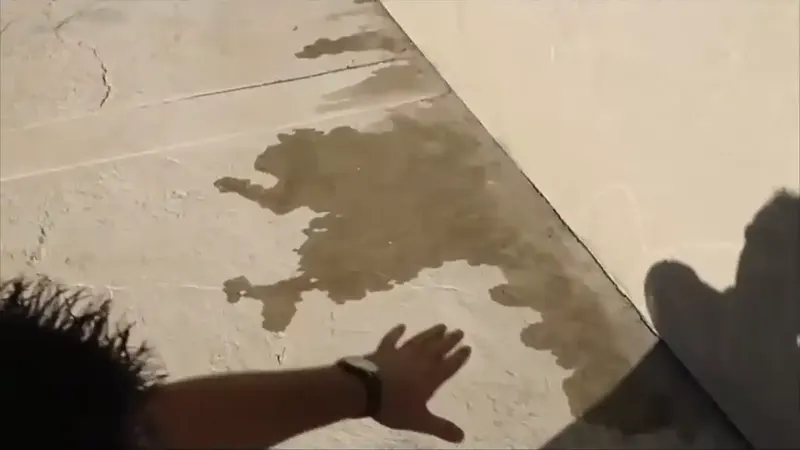
Most of Aliso Viejo sits on graded pads cut into the Saddleback Valley slopes at elevations around 300 to 450 feet. Unlike a flat-lot home in a basin city, a hillside pad has a slope gradient built into the concrete from the day it was poured. When a supply line fails under that slab, the released water finds the path of least resistance, which is the pad slope. It can travel horizontally under the concrete for ten or fifteen feet before finding a crack to surface through, and when it does surface, the wet spot on the floor may be in a completely different room from the broken pipe.
This behavior makes visual inspection unreliable for locating slab leaks in Aliso Viejo. We use acoustic ground microphones pressed against the concrete surface to detect the distinct frequency produced by pressurized water escaping a pipe under the slab. The signal is narrow and directional; moving the sensor across the floor in a grid pattern lets us triangulate the break to within one to two feet. We then confirm with a pressure test, isolating the supply circuit and watching the gauge for drop. Only after both acoustic location and pressure confirmation do we cut concrete, and then only over the confirmed break point. You can read more about our location methodology on the acoustic leak detection service page.
The San Joaquin Hills Fault is a blind thrust fault that literally pushed up the hills Aliso Viejo sits on over geologic time. Active tectonic movement from the San Joaquin Hills system, combined with the nearby Newport-Inglewood Fault Zone, means the soil beneath graded pads in this city experiences slow cyclic stress. That stress concentrates at pipe joints and elbows, making the already-vulnerable 1980s and 1990s copper cohort more susceptible to failure at those connection points specifically. We check elbows and tee-joints first when a pressure test confirms a slab leak in a first-phase Aliso Viejo neighborhood.
Repair Options After We Locate the Leak
Once we have the leak located and pressure-confirmed, there are three standard repair paths depending on how the rest of the system tests.
Spot repair is appropriate when this is the first detected failure in the system and surrounding pipe sections test at normal pressure. We open the slab over the break, repair or replace the damaged section, retest, and patch the concrete. For a Glenwood home with 1985 copper that is otherwise tight, spot repair is often the right call for an isolated elbow failure.
Pipe rerouting bypasses the failed section entirely by running a new line through the walls or ceiling instead of back under the slab. This makes sense when the break is at a difficult access point under the slab or when the homeowner wants to avoid any future sub-slab repair in that circuit. The rerouted line is typically PEX, which is resistant to the mineral scaling that accelerates copper failure.
Whole-house repipe replaces all supply lines at once, which is the appropriate response when pressure testing shows multiple failures or when the system is a 1980s copper Westridge home showing wall staining in several locations. We cover this in detail on the whole-house repipe service page. For a home where the copper cohort has entered widespread failure, a full PEX repipe eliminates the pattern rather than chasing it one break at a time.
We do not recommend a repair path before we know what the rest of the system looks like. Pressure testing the full supply circuit takes thirty minutes and gives us the information we need to advise you honestly. Call (949) 325-3122 to schedule same-day.
Signs You May Have a Slab Leak
In Aliso Viejo's hillside homes, the warning signs of a slab leak do not always appear where the leak is. Watch for a warm or damp area on tile or hardwood flooring that does not correspond to any visible plumbing above it, a sudden unexplained increase in your Moulton Niguel Water District bill, low water pressure at multiple fixtures simultaneously, and the sound of running water when all taps and appliances are off. A musty or mildew smell in a room without visible moisture source is also worth investigating, as it often indicates water has been releasing under the slab long enough to create a damp environment in the underlayment or concrete itself.
If you observe any combination of these signs in a Glenwood, Westridge, Audubon, or California Renaissance home, the pipe age and water chemistry make a slab leak the most likely explanation. Call (949) 325-3122 and we will have a technician to your address with acoustic equipment the same day.
Frequently Asked Questions
On a graded hillside pad, the water follows the slope of the pad rather than pooling directly above the break. You may notice a damp or warm area on the floor several feet from where the pipe actually failed. Other signs include a sudden increase in your Moulton Niguel Water District bill, low water pressure at multiple fixtures, and a faint hissing or running-water sound when all taps are off. Call (949) 325-3122 for a same-day assessment.
We use acoustic ground microphones and electronic amplification equipment to listen for the pressure-drop frequency produced by a pipe break under the slab. We confirm the location with pressure testing before any concrete work begins. In most Aliso Viejo homes we locate the leak to within one to two feet, which allows targeted access rather than a full slab removal.
Yes, and the risk is amplified on graded hillside pads. Sustained water release under a hillside slab erodes the compacted fill beneath the pad, which can lead to differential settlement. The San Joaquin Hills Fault system also means the soil here experiences slow tectonic movement; combining that with water-saturated fill significantly raises the risk of pad shifting. If you also notice cracks appearing in interior walls, also have a look at what we document on foundation leak detection.
Most California homeowner policies cover sudden, accidental water damage but not the pipe repair itself. Many policies include access coverage, which pays for opening the slab to reach the leak. We document all findings with photos and a written report to support your insurance claim. Call (949) 325-3122 and we will walk you through what to tell your adjuster.