
Thermal Imaging Leak Detection in Aliso Viejo, CA
Thermal imaging detects the temperature difference that moisture creates in slab, wall, and ceiling surfaces. An infrared camera reveals wet areas as cooler zones against the warmer dry background, mapping the extent of moisture migration without opening any surface. In Aliso Viejo's slab-on-grade homes, thermal imaging is particularly useful for confirming a slab leak's general location and mapping the water migration path before acoustic scanning narrows the precise failure point. Call (949) 325-3122 for thermal imaging leak detection throughout South Orange County.
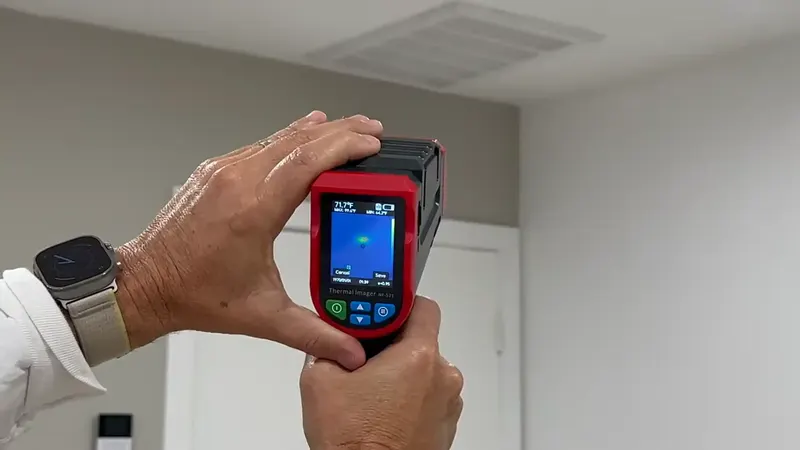
How Infrared Cameras Detect Moisture in Aliso Viejo Homes
Water evaporates from wet concrete, drywall, and flooring surfaces at a rate that cools those surfaces slightly relative to dry surrounding materials. An infrared camera detects this surface temperature differential as a distinct color signature in the thermal image, mapping wet areas as cooler zones against the warmer dry background. In a slab-on-grade home in The Heights, California Renaissance, or Stoneridge, thermal imaging of the tile or hardwood floor surface after a slab leak has been active for some time reveals the moisture migration path from the failure point outward across the pad surface. The thermal pattern gives us both a direction-of-origin indicator and a map of how far the water has spread before surfacing.
Thermal imaging works best when there is an active temperature differential between wet and dry areas. In Aliso Viejo's warm Mediterranean climate, the outdoor temperature typically produces enough differential during cooler early-morning hours to create readable thermal contrast on interior surfaces. We schedule thermal imaging assessments for the early morning on properties where the ambient temperature differential will be highest. For slabs where water has been releasing slowly for weeks, the thermal pattern may be subtle; we supplement thermal imaging with moisture meter readings at the highest-temperature-contrast points to confirm active moisture in the material. For the acoustic scanning that typically follows thermal mapping to pinpoint the failure, see our acoustic leak detection page.
Thermal imaging of wall and ceiling surfaces is particularly useful for locating drain-side leaks that only release water during fixture use. We run the fixture above (shower, tub, or sink) and immediately image the ceiling or wall below with the infrared camera. Active drain connection leaks produce a temperature differential in the ceiling or wall that appears within minutes of fixture use, allowing us to map the drip path and identify the failure location before making any access cut. For ceiling-specific leak assessment see our ceiling leak repair page. Call (949) 325-3122.
Thermal Imaging for Moisture Extent Assessment
Beyond locating the failure, thermal imaging provides a moisture extent map that is essential for insurance documentation and for deciding whether the repair scope extends beyond the pipe fix to include remediation of surrounding materials. A slab leak in a Stoneridge or California Cortina home that has been active for several weeks may have spread moisture through 10 to 20 square feet of floor assembly around the failure point. The thermal image maps this area definitively, which supports an insurance claim for floor and underlayment remediation beyond just the pipe repair. We include thermal images in our written assessment report. Call (949) 325-3122.
Frequently Asked Questions
Yes. Tile conducts temperature differentials reasonably well, and the moisture beneath the tile creates a detectable thermal signature at the tile surface. The contrast is less pronounced than on bare concrete or directly on drywall, but it is readable with a high-sensitivity infrared camera during conditions of appropriate temperature differential. For deeper moisture beneath thick mortar beds, moisture meter confirmation supplements the thermal reading. Call (949) 325-3122.
A thermal scan of a suspected floor area in a typical Aliso Viejo home takes 15 to 20 minutes and produces an immediate image map. We typically do thermal scanning as the first step when arriving at a leak call, before setting up acoustic detection equipment, because the thermal image confirms or redirects the suspected leak zone before the acoustic scan begins. The combination of thermal mapping plus acoustic confirmation is faster overall than either method used alone. Call (949) 325-3122.
Yes. Moisture in a wall cavity creates a cooler surface temperature on the drywall face that is detectable with an infrared camera. This is particularly useful for locating the extent of moisture spread in wall framing after an active pipe failure, and for identifying the drip path from a drain-side failure in a second-floor bathroom ceiling. We run the fixture, then image immediately to catch the active thermal response. Call (949) 325-3122.