
Ultrasonic Leak Detection in Aliso Viejo, CA
Ultrasonic leak detection uses sensors tuned to the high-frequency acoustic range above standard hearing that pressurized water turbulence produces at a pipe failure. While standard acoustic detection operates in the audible frequency range, ultrasonic detection captures the higher-frequency components of the same escape signature, which can provide a sharper location signal in environments with significant low-frequency background noise such as traffic, HVAC, or plumbing flow in adjacent circuits. Call (949) 325-3122 for ultrasonic and acoustic leak detection throughout South Orange County.
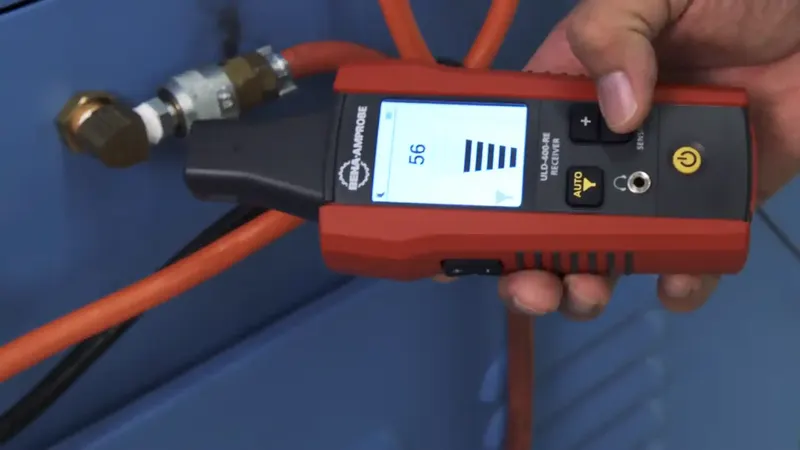
When Ultrasonic Detection Provides an Advantage
Standard acoustic ground microphone detection is the primary method for locating pressurized pipe failures in Aliso Viejo homes, and it handles the vast majority of slab and wall leak calls successfully. Ultrasonic detection provides an advantage in specific environments where low-frequency background noise would otherwise mask the standard acoustic signal. Properties near Aliso Viejo's main arterial roads, near Summit Office Campus mechanical equipment, or in multi-unit buildings in Vantis and Aliso Viejo Town Center where HVAC fans and pump noise create sustained low-frequency background interference may benefit from the higher-frequency ultrasonic sensor, which is less affected by that low-frequency noise floor.
The ultrasonic sensor is also useful for locating pressurized gas leaks at fittings and connections, though our primary scope here is water supply lines. For water pipe failures specifically, the ultrasonic signal from a pressurized escape through a pinhole in MNWD-supplied copper is strongest in the 20-to-40 kHz range, well above the noise floor from HVAC and traffic. We bring ultrasonic detection equipment to every assessment and select between standard acoustic and ultrasonic modes depending on the ambient noise environment encountered on arrival. For the combined acoustic-plus-electronic approach we use for buried line tracing, see our electronic leak detection page.
Ultrasonic Detection on Pool and Spa Plumbing
Pool and spa plumbing failures, particularly at fittings and connections that carry pressurized return flow, can be located with ultrasonic detection when the fitting is not accessible for visual inspection or for pressure testing in isolation. We use the ultrasonic sensor to scan along the pool plumbing manifold and at fitting locations around the equipment pad, listening for the turbulence signature of a pressurized flow bypass at a failed fitting. This supplements the pressure testing and dye testing described on our pool leak detection page. For the acoustic scanning used on buried pool supply lines, the acoustic leak detection method applies. Call (949) 325-3122.
Frequently Asked Questions
Both methods detect the sound produced by pressurized water escaping through a pipe failure. The difference is frequency range: standard acoustic detection operates in the audible range (roughly 300 to 2,000 Hz) while ultrasonic detection captures higher frequencies above 20 kHz. Ultrasonic sensors are less affected by low-frequency background noise from HVAC, traffic, and building equipment. We select the appropriate mode based on the ambient environment at each property. Call (949) 325-3122.
We use ultrasonic mode when the ambient low-frequency noise at a property would mask the standard acoustic signal. This occurs most often in multi-unit buildings near mechanical equipment, in homes near high-traffic arterial roads, and in commercial properties at Summit Office Campus and Pacific Park Plaza where HVAC systems run continuously. For most residential Aliso Viejo homes with normal ambient noise, standard acoustic detection provides adequate signal clarity. Call (949) 325-3122.
Yes. Ultrasonic sensors detect the turbulence from pressurized flow bypassing a failed fitting or connection in pool plumbing equipment. We use it at pool equipment pads to scan manifold fittings and at accessible plumbing connections around the pool shell perimeter. For buried pool supply line failures, pressure testing and acoustic scanning are the primary methods. Call (949) 325-3122.